
- This event has passed.
Remembering Their Valor, Fidelity, and Sacrifice: The 82nd Anniversary of the Allied Landing in Normandy
June 6th @ 11:00 am - 12:00 pm EDT
FreeThe 82nd anniversary of the Allied landing at Normandy and the 25th anniversary of the National D-Day Memorial will be marked with a special ceremony.
Parking for June 6 Ceremony
On-site parking at the Memorial will be available to:
- World War II veterans
- Disabled with placard or plate
- D-Day Society members
- General public (first come, first served)
Once on-site parking is full, arriving guests will be directed to a nearby overflow lot, with shuttle buses running to the Memorial site.
Please plan to arrive by 10:30AM. The last bus will depart overflow parking for the Memorial at 10:45AM.
Buses will begin departing from the Memorial back to the overflow lots immediately following the ceremony (approximately 12:30PM).
For safety, pedestrian traffic to and from the Memorial site is not allowed.
Drew Dix, Medal of Honor Recipient
Keynote Speaker
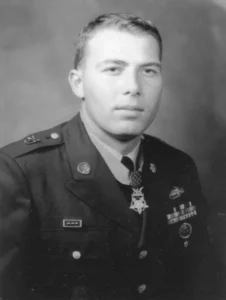 Drew Dix joined the U.S. Army in 1962 in Pueblo, Colorado at the age of seventeen. He was assigned to the 82nd Airborne Division where he was deployed to the Dominican Republic for his first combat tour. He remained with the 82d until he met the age requirements for the U.S. Army Special Forces. Following graduation from the operations & intelligence course, Dix attended Spanish language and High-Altitude parachute training courses before being deployed to the Republic of Vietnam, where he was assigned to a highly classified project with the mission of eliminating enemy infrastructure. Assigned as a lone American, he led multiethnic mercenaries on missions throughout the region. After receiving a direct commission, Dix was assigned back to Vietnam as a Company Commander of A co, 2/502,101st Airborne Division. In addition to the 82d, and the 101st, Drew was assigned to the 5th & 6th Special Forces Groups, aide to the CG of the JFK Special Warfare Center, and aide to the CG XVIII Airborne Corps. As a Special Forces Sergeant, during his first tour Dix became the first enlisted man in the U.S. Army Special Forces to receive the Medal of Honor.
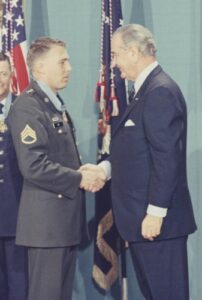
SSgt Drew Dix receives Medal of Honor from President Lyndon B. Johnson, 1969
For conspicuous gallantry and intrepidity in action at the risk of his life above and beyond the call of duty. S/Sgt. Dix distinguished himself by exceptional heroism while serving as a unit adviser. Two heavily armed Viet Cong battalions attacked the Province capital city of Chau Phu resulting in the complete breakdown and fragmentation of the defenses of the city. S/Sgt. Dix, with a patrol of Vietnamese soldiers, was recalled to assist in the defense of Chau Phu. Learning that a nurse was trapped in a house near the center of the city, S/Sgt. Dix organized a relief force, successfully rescued the nurse, and returned her to the safety of the Tactical Operations Center. Being informed of other trapped civilians within the city, S/Sgt. Dix voluntarily led another force to rescue 8 civilian employees located in a building which was under heavy mortar and small-arms fire. S/Sgt. Dix then returned to the center of the city. Upon approaching a building, he was subjected to intense automatic rifle and machine gun fire from an unknown number of Viet Cong. He personally assaulted the building, killing 6 Viet Cong, and rescuing 2 Filipinos. The following day S/Sgt. Dix, still on his own volition, assembled a 20-man force and though under intense enemy fire cleared the Viet Cong out of the hotel, theater, and other adjacent buildings within the city. During this portion of the attack, Army Republic of Vietnam soldiers inspired by the heroism and success of S/Sgt. Dix, rallied and commenced firing upon the Viet Cong. S/Sgt. Dix captured 20 prisoners, including a high ranking Viet Cong official. He then attacked enemy troops who had entered the residence of the Deputy Province Chief and was successful in rescuing the official’s wife and children. S/Sgt. Dix’s personal heroic actions resulted in 14 confirmed Viet Cong killed in action and possibly 25 more, the capture of 20 prisoners, 15 weapons, and the rescue of the 14 United States and free world civilians. The heroism of S/Sgt. Dix was in the highest tradition and reflects great credit upon the U.S. Army.
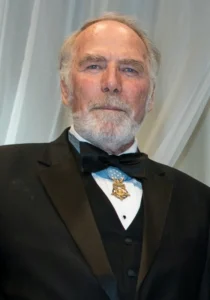
Dix was instrumental in establishing the Joint Special Operations Support Element (JSOSE) at MacDill AFB in Tampa, FL., and was assigned to the 4th BN, 9th INF at Ft Wainwright, Alaska. Following the attacks of September 11, Dix was asked by the Governor of Alaska to advise him on the strategies that should be used to protect the oil infrastructure in Alaska. He served as Alaska’s first Director of Homeland Security. Dix retired from the State of Alaska as a Deputy Commissioner within the Department of military and Veterans affairs. His early beginning in special operations paved the way for Dix to work in numerous anti- terrorist assignments following his twenty years of service in the U.S. Army. While living in Alaska he worked on a classified contract from 1985 to 1995, with the mission to establish Ice Stations on the Arctic Ocean to track Soviet submarines. Dix also served in the Middle East and Central America. While in Alaska, he owned and operated an air service and flew throughout the northern regions of the state.
He is the C0-Founder of the “Center for American Values” an educational nonprofit in Pueblo, Colorado where he served as the Board Chairman until being elected as President of the Congressional Medal of Honor Society. He is on the board of The Center for American Values. He founded REMUDA, LLC which specializes in providing training to active military and other government entities, speaking to those deploying and/or returning from deployment. He now lives with his wife Patricia on their ranch in Westcliffe, CO.
Gates open at 9:30AM. Free admission until 5:00PM. Please bring your own chair. No food in plaza. No pets (service animals welcome).
Thank you to our 82nd Anniversary of D-Day commemoration sponsors.